Rules and trust
Do You Have to Tell Callers an AI Is Answering in Australia?
By Vistic AI editorial teamUpdated 9 min readDraft, not yet reviewed by a lawyer
The short answer
We found no Australian law that says in so many words you must announce "this is an AI" at the start of a call, but the Privacy Commissioner's guidance says public-facing AI tools should be clearly identified as such, and a privacy policy duty for automated decisions starts on 10 December 2026. Whether the Privacy Act applies to you depends on your turnover and what you do: most small businesses with turnover of $3 million or less are not covered, but some are. The safe, honest practice is to tell callers an AI is answering in Australia in the first sentence. This is general information, not legal advice, and it has not yet been reviewed by a lawyer.
Is there a rule that you must tell callers an AI is answering in Australia?
You do not have to, according to anything we could find in statute, but you should. We found no Australian law that expressly requires a business to announce that an AI is answering a phone call. That is a limited statement: our search tools are weak on Australian legislation, and some government pages blocked us. The OAIC does say that public-facing AI tools should be clearly identified as such to customers, and being clear costs nothing.
What does the OAIC say about telling people they are talking to AI?
The OAIC's guidance on commercially available AI products says organisations should update their privacy policies and notifications, and ensure that any public-facing AI tools, such as chatbots, are clearly identified as such to external users such as customers. It was published on 21 October 2024 and updated on 17 January 2025. It is guidance on how the Privacy Act applies, not a separate law.
Is it illegal for an AI to pretend to be a human?
We could not verify a specific rule for phone calls, so we will not say. Misleading customers can raise other issues, such as consumer law, and that is a question for a lawyer. Whatever the law says, a caller who finds out later that they were talking to software often feels tricked, which is a business problem even where it is not a legal one.
Does the Privacy Act apply to a tradie or small business?
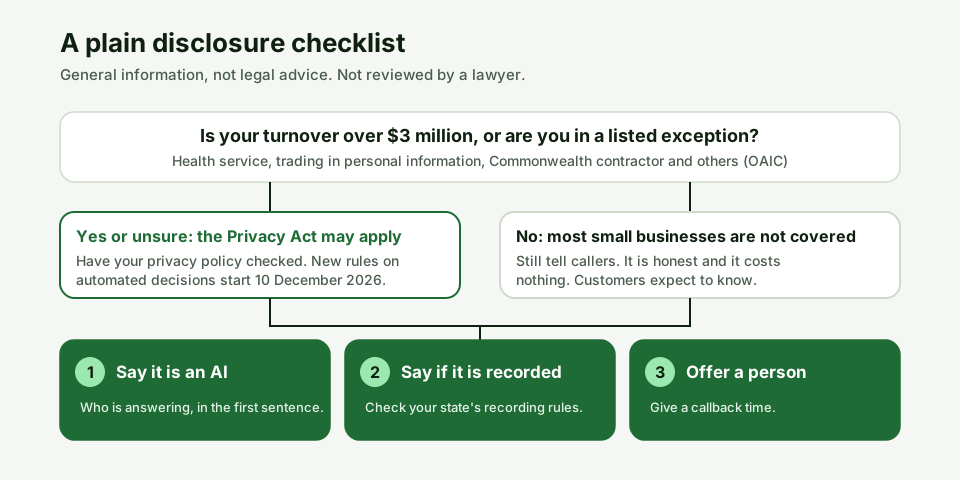
The Privacy Act applies to most businesses with annual turnover above $3 million and to some smaller ones. The OAIC says most small businesses are not covered, but some are. If your turnover is $3 million or less you are generally outside the Act, unless an exception applies.
Which small businesses are covered by the Privacy Act regardless of turnover?
According to the OAIC, a small business is covered if it is a health service provider, trades in personal information, is a Commonwealth contractor, operates a residential tenancy database, is a credit reporting body, is a reporting entity under the anti-money laundering law, is related to a covered business, has opted in, or is prescribed by regulation. A tradie who only books jobs and takes names and addresses is not obviously in one of those groups, but check the OAIC page, and note that a business that is part of a larger group may be.
Does it matter if the Privacy Act does not apply to me?
It matters less for the legal duty and more for trust. Even if the Act does not apply to you, customers reasonably expect to know who or what has their name, address and phone number. If you take on larger clients, or grow past the threshold, you will want the practice in place.
What changes on 10 December 2026?
From 10 December 2026, businesses covered by the Privacy Act must put information in their privacy policy where a computer program makes, or substantially and directly informs, a decision that could reasonably be expected to significantly affect an individual's rights or interests, and personal information is used. These are Australian Privacy Principles 1.7 to 1.9, added by the Privacy and Other Legislation Amendment Act 2024. The OAIC published resources on 30 September 2026.
Is booking a job an automated decision?
A receptionist that only collects a name, address and a job description and offers a time that you have opened is probably not making a decision that significantly affects someone's rights or interests, but that is a legal judgement, and we are not giving it. It is a question to put to a lawyer if you are covered by the Act. A receptionist that decides who gets a service, who is refused or what they pay is a closer call.
What do you have to write in your privacy policy?
If the new rule applies to you, APP 1.8 sets out what the policy must say. Read the OAIC's resources and ask a lawyer to check the wording. We have not reproduced the list here, because we have not verified it line by line against the legislation.
Do you need permission to record the call?
Recording laws are separate and set by each state and territory, so the rules differ. We cover them on our page about call recording laws in Australia, which lists the state statutes. We have not verified the NSW Act directly, so we do not summarise it here. If your AI receptionist records or transcribes calls, say so at the start of the call.
What should the opening line say?
The opening line should say who is answering, that it is an AI, and what it can do, in one sentence. For example: "G'day, you've reached Sam's Plumbing. I'm an AI receptionist, and I can book you a time or take a message." It tells the caller in plain words, and it does not need a legal disclaimer.
Does telling callers it is an AI lose bookings?
We have no Australian data on that, and we will not invent any. In our own testing of demo calls we have not measured it either. What we can say is that a caller who is told clearly and then gets a fast, useful answer has a reason to stay, and a caller who is surprised has a reason to hang up.
How should the AI hand over to a person?
It should offer a person whenever the caller asks, and say what will happen next: "I'll pass this to Sam, who'll call you back before 9am." A customer who asks for a human should get one, or a clear time they will get one.
What should you put on your website and in your privacy policy?
Say that you use an AI receptionist to answer calls and messages, what information it collects, where it is stored and who can see it. Keep it short and plain. If you are covered by the Privacy Act, get your privacy policy checked by a lawyer, especially after 10 December 2026.
How does AI receptionist disclosure work in practice in Australia?
AI receptionist disclosure in Australia is mostly a matter of three habits: say it at the start of the call, say what happens to the information, and offer a person. The figure below shows the order we suggest. It is a plain-language checklist, not a legal test.
Is there an exemption for small business?
There is a small business exemption in the Privacy Act, for most businesses with turnover of $3 million or less, with the exceptions listed above. The privacy act small business exemption is about the legal duty only. It does not stop a customer from expecting you to be straight with them. It also does not cover businesses that trade in personal information or provide health services.
What is the three million dollar turnover threshold?
The three million dollar turnover threshold is the annual turnover line the OAIC uses to define a small business under the Privacy Act. Below it, most businesses are not covered, with the exceptions listed earlier. Check your own turnover against the OAIC page, because related companies can count together.
What should a voice agent disclosure to callers include?
An AI voice agent disclosure to callers should be short: that it is an AI, who it is answering for, and, if you record or transcribe, that the call is recorded. Add a call recording notice for an AI receptionist in the same breath rather than as a separate warning, so the caller hears it once. Public-facing AI tools should be clearly identified, in the OAIC's words, and the opening line does that.
What does a good privacy policy wording look like?
Good AI receptionist privacy policy wording is plain: "We use an AI receptionist to answer calls and messages. It collects your name, address and what you need, so we can book a job. Calls may be recorded. You can ask to speak to a person." That is an example of tone, not approved legal text. If the new automated decision rules apply to you, have a lawyer check the policy.
Is telling customers you use AI a good idea for trust?
Telling customers you use AI is good practice for trust, whatever the law requires. Put a line on your website and your quote emails, not only on the call. Our AI receptionist page shows how the opening line is set up.
How should the AI hand over to a human?
Handover to a human should be quick and specific: a callback time, a name and what the caller has already said, so they do not repeat themselves. See how this works in our guide to forwarding calls to an AI receptionist.
Is an AI answering service legal in Australia?
We found nothing that makes an AI answering service unlawful in itself, but the details, such as recording, privacy and consumer law, depend on how you run it. Our page on call recording laws in Australia covers the state side. Ask a lawyer about your own setup.
Quick answers to common questions
Must I tell customers an AI is answering?
We found no law that expressly requires it, but the OAIC says public-facing AI tools should be clearly identified as such. Telling callers in the first sentence is the safe practice. This is not legal advice.
Does the Privacy Act apply to small businesses?
Most small businesses with turnover of $3 million or less are not covered, but some are, for example health service providers and businesses that trade in personal information.
What happens on 10 December 2026?
Businesses covered by the Privacy Act must describe certain automated decisions in their privacy policy. Check the OAIC resources and ask a lawyer whether it applies to you.
Can I record calls handled by an AI receptionist?
Recording laws are state based. See our page on call recording laws and tell callers at the start if calls are recorded.
Is there a small business exemption?
For most businesses with turnover of $3 million or less, with listed exceptions. It does not remove the case for being honest with callers.
Do I need a call recording notice?
Say at the start if calls are recorded or transcribed, and check your state's rules.
What should the AI say at the start of a call?
Who is answering, that it is an AI, and what it can do, in one sentence.
Sources
- Office of the Australian Information Commissioner, Guidance on privacy and the use of commercially available AI products, published 21 October 2024, updated 17 January 2025.
- OAIC, Small business.
- OAIC, New resources on transparency for use of AI and automated decision-making, 30 September 2026.
See also our guides to AI receptionist costs and the Insights hub.
Updated 22 November 2026. Status: DRAFT, not reviewed by a lawyer. Corrections log: none yet. Vistic AI sells an AI receptionist, so we have a commercial interest in how this topic is framed.