Costs and comparisons
AI Receptionist vs Hiring a Receptionist in Australia
By Vistic AI editorial teamUpdated 10 min read
The short answer
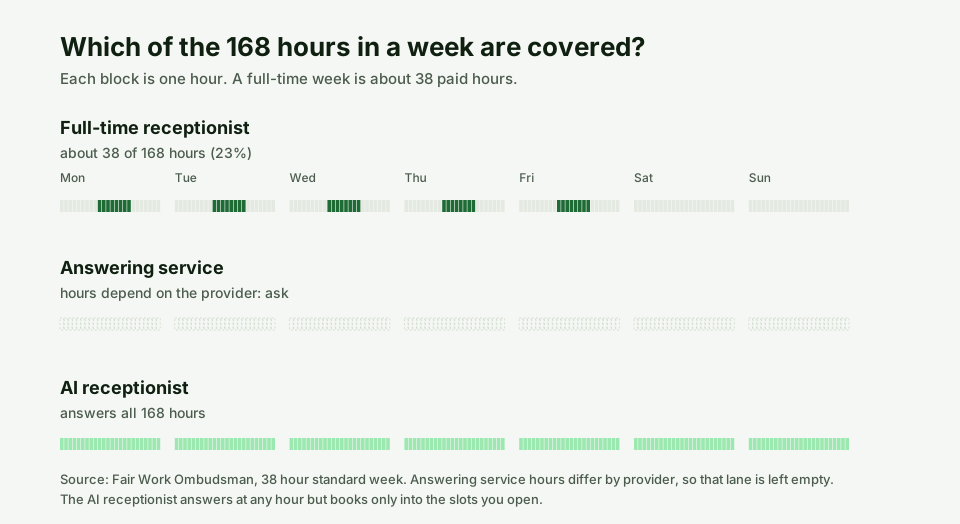
For a small trade or service business, AI receptionist vs hiring a receptionist in Australia comes down to hours covered, not only price. A full-time clerk on the Fair Work award rate costs roughly $60,000 to $69,000 a year with super at Levels 1 to 3, and covers about 38 of the 168 hours in a week. A live answering service starts from about $25 a month plus GST. An AI receptionist plan, such as ours at $149 a month, answers at every hour but cannot do the in-person parts of a front desk job. Which one fits depends on how many calls you get, when they come in and what else the person would do.
AI receptionist vs hiring a receptionist in Australia: which costs less?
An AI receptionist is cheaper than a hired receptionist on price alone, but the two are not doing the same job. A clerk answers calls for 38 hours a week and also greets visitors, handles mail and does admin. An AI receptionist answers calls and messages at any hour and writes up the job, and nothing else. Compare the work you need done, not just the price tag.
What does a receptionist cost in Australia?
A receptionist costs at least the award minimum plus super and the costs of employing someone. The Fair Work Ombudsman pay guide for the Clerks Private Sector Award lists $26.97 an hour at Level 1 in the first year, $29.45 at Level 2 and $31.11 at Level 3, from the first full pay period on or after 1 July 2026. We do not assign a level to a receptionist, because the award text we read does not name the role: classification depends on the duties, and you should check yours with Fair Work.
How much does a full-time receptionist cost per year?
A full-time receptionist costs about $60,000 to $69,000 a year at Levels 1 to 3 once you add 12 percent super, before leave loading, workers compensation, equipment and training. We calculated it from the weekly award rates of $1,024.70, $1,119.10 and $1,182.10, over 52 weeks, plus 12 percent.
| Award level | Hourly (first year) | 38-hour week | Year with 12% super |
|---|---|---|---|
| Level 1 | $26.97 | $1,024.70 | about $59,700 |
| Level 2 | $29.45 | $1,119.10 | about $65,200 |
| Level 3 | $31.11 | $1,182.10 | about $68,800 |
Fair Work Ombudsman pay guide, Clerks Private Sector Award, from 1 July 2026. Annual figures are our arithmetic: weekly rate x 52 x 1.12. They exclude leave loading, workers compensation, equipment and recruitment. Not a statement of which level applies to any role.
What is the minimum wage for a receptionist in Australia?
The national minimum wage is $26.44 an hour, or $1,004.90 a week, from 1 July 2026. Award rates are usually higher, and an award can set penalty rates on top. A receptionist covered by an award cannot be paid below it.
What does a casual or part-time receptionist cost?
A casual receptionist costs the award hourly rate plus a 25 percent casual loading, so a Level 1 first-year rate of $26.97 becomes about $33.71 an hour before super. Part-time staff are paid the base rate for the hours worked, with leave accruing. The hourly price is higher for casuals, and you only pay for the hours you roster.
What do penalty rates add for evenings and weekends?
Penalty rates add a lot for work outside normal hours. Under the Clerks Award, Saturday is paid at 125 percent, Sunday at 200 percent and public holidays at 250 percent. At Level 2, first year, that is $36.81, $58.90 and $73.63 an hour. Cover for the hours when tradies are busiest on the phone is the most expensive cover to hire.
How many hours does a receptionist actually cover?
A full-time receptionist covers about 38 of the 168 hours in a week, or 23 percent. Take out breaks, leave, sick days and public holidays and the real number is lower. The gap between a clerk's hours and your customers' hours is where missed calls sit.
Who answers the phone when the receptionist is on leave?
Nobody, unless you plan for it. A permanent employee takes four weeks of annual leave plus sick leave, and a small business rarely has a second person trained to cover. An AI receptionist or an answering service has no leave to cover.
Can a receptionist cover after hours?
A receptionist can cover after hours only if you pay for the hours, at penalty rates on weekends and public holidays, or if you roster casual staff. Few small trades do. Most send after-hours calls to voicemail, which is where the survey evidence on missed calls bites. See our guide to the cost of missed calls for tradies.
How much does a live answering service cost?
A live answering service costs from about $25 a month for message-taking, plus GST, and more for transfers and bookings. OfficeHQ lists live answering from $25 a month for message-taking and from $35 a month for call transfers, with a diary booking tier from $50. Its pay-per-call MyReceptionist 50 plan is $190 a month excluding GST, and it says the actual cost depends on call volume. These are one provider's "from" prices, not an Australian average.
What does an answering service do that an AI does not?
A live answering service puts a person on the line, which matters for upset callers, emergencies and calls that need judgement. The person reads a script, so what they can do is limited to what you have written down. An AI receptionist follows a script the same way, and it answers at any hour with no extra charge for nights and weekends on most plans.
What does an answering service not do?
It does not know your diary unless you give them access, and many only take messages. If you want the caller booked into a real slot, ask the service whether it can do that, and whether it costs extra.
What does an AI receptionist cost compared with a hire?
An AI receptionist costs a monthly plan, and for our own Answer Solo plan that is $149 a month. Plans differ on included minutes and features, and the AI receptionist cost guide shows how to convert calls to minutes. The sums are not close: a year of a plan costs a small fraction of a year of a full-time wage. The comparison that matters is what each does with a call.
What can an AI receptionist do that a person cannot?
An AI receptionist answers every call at the same speed at any hour, including three calls at once, and never goes on leave. It asks the same questions each time and writes a job card. That is the value for a tradie who is under a sink at 11am and wants a booking waiting at 5pm.
What can a person do that an AI receptionist cannot?
A person can greet someone at the counter, take a parcel, calm an angry customer, use judgement outside a script, and be accountable in a way a caller recognises. If your business has a shopfront or a waiting room, you may still want one. If most of your front desk work is the phone, you may not.
Can an AI receptionist replace a human receptionist?
It can replace the phone-answering part of the job, not the job. Decide which duties the role actually contains. If it is 70 percent phones, an AI receptionist covers most of it. If it is 70 percent in-person service, it does not.
Which is best for a tradie or small business?
The best option for a tradie depends on call volume, hours and whether you have a counter. Our rule of thumb has three cases, and it is a rule of thumb, not a study.
- Sole trader or a crew of two to five on the road. An AI receptionist or a live answering service, because a wage is out of proportion to the call volume.
- A business with a shopfront or reception area. A person at the counter, with an AI receptionist for after hours and overflow.
- A busy multi-site business. A person or a team for the front desk, with an AI receptionist taking overflow and out-of-hours calls.
Is a part-time receptionist or an AI receptionist better for a small business?
For a tradie the question is usually an AI receptionist for tradies against a live answering service for tradies, because a wage is out of proportion to the call volume.
A part-time receptionist is better when you need in-person presence on set days and the phone volume is steady. An AI receptionist is better when calls arrive at all hours and you want them booked at any time. Many small businesses use both.
Can you use an AI receptionist and a person together?
Yes, and for many businesses it is the best option. The AI answers when the person is busy, on leave or finished for the day, and hands over the calls that need a human. Our AI receptionist page shows how the handover works.
How do you compare the options on your own numbers?
You compare them by working out three things: how many calls you get, how many arrive outside the person's hours, and what a booked job is worth to you. The front desk assessment asks six questions and tells you plainly when you do not need a plan. The 24-hour day simulator shows the same day with and without an AI receptionist.
Quick answers to common questions
Is an AI receptionist cheaper than a human receptionist?
Yes on price. A full-time clerk costs about $60,000 to $69,000 a year at Levels 1 to 3 with super, and an AI receptionist plan costs a small fraction of that. They are not doing the same job, so compare the duties.
How much does a receptionist cost in Australia?
At the Clerks Award rates from 1 July 2026, $26.97 to $31.11 an hour at Levels 1 to 3 in the first year, plus 12 percent super and other employment costs. Check the right level for your duties with Fair Work.
How many hours does a receptionist cover?
About 38 of the 168 hours in a week, which is 23 percent. Less after leave and public holidays.
How much is an answering service in Australia?
OfficeHQ lists live message-taking from $25 a month and transfers from $35 a month, plus GST, with extra for add-ons. Prices vary by provider and call volume.
Can an AI receptionist replace a receptionist?
It can replace the phone work, not the in-person work. Decide what the role actually does.
Can I use both an AI and a person?
Yes. Many businesses let the AI handle after-hours and overflow calls, and keep a person for the counter and the calls that need judgement.
Sources
- Fair Work Ombudsman, Minimum wages, as of 1 July 2026, and the pay guides, Clerks Private Sector Award [MA000002], published 24 June 2026.
- Fair Work Commission, Clerks Private Sector Award 2020, clause 11.1 casual loading and penalty rates.
- Australian Taxation Office, Super guarantee rate, 12 percent from 1 July 2025.
- OfficeHQ, pricing and pay-per-call. Vendor prices, plus GST, opened 22 November 2026.
Updated 22 November 2026. Corrections log: none yet. Vistic AI sells an AI receptionist, so we have a commercial interest in this comparison. Annual wage figures and the 23 percent coverage figure are our arithmetic from the sources above.